Showing posts with label cycle paths. Show all posts

Wednesday, 29 May 2013

The Media and the Message


What with the ongoing Times Cities Fit For Cycling campaign, and the significant debates surrounding the Parliamentary Enquiry into Cycling, it's easy to forget the typical media take on cycling. 

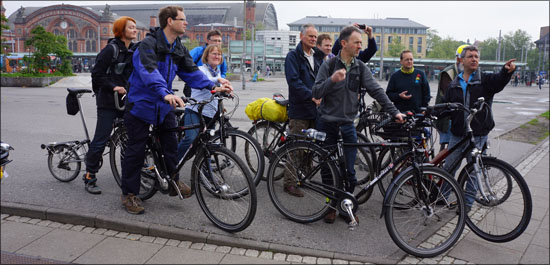
Yesterday we welcomed members of Cambridge Cycling Campaign to Bremen for a tour of the city's infrastructure. The fact that the Campaign contacted us, rather than the ADFC or the local authority, is itself a significant reflection of Bremen's lack of official international engagement. But we were more than happy to offer a semi-outsider's narrative of why our home city is so cycling friendly.

The tour itself took in a series of examples of infrastructure that explained the historical and cultural stories behind Bremen's remarkable status as the German cycling city - one of the first cycle paths (early 1900's) along Am Wall; the rather tired and ageing cycle paths of the 1920's that are suffering from tree roots, the site of the great battle of the 1970's, Mozartstrasse, that stopped the building of an urban motorway through a residential district and helped transform the city's transport policy; the resultant calming of the area through a series of one-way streets for motor traffic, all passable two-way for cyclists; the provision of decent-quality cycle paths along all major routes; and some of the most recent developments, such as a new protected cycle lane on Herdentor, created through the conversion of a full-width traffic lane. 

Throughout the three-hour tour, we were followed by a very friendly camera crew from Radio Bremen, who wanted to produce a short piece for that evening's local news transmission. Now we were so caught up in preparing the content of the tour - you know the stuff, history, culture, technical standards of infrastructure and so on - that we quite overlooked the media take on what we were doing, and how it might be redacted by our nice TV crew.  Radio Bremen, along with the wider trend in broadcast television, is increasingly interested in populist angles, amusing titbits that make the audience smile, but might not impart much knowledge about the subject in question. But sometimes it works.

Let's have a bit of fun ourselves, shall we, and consider the piece that went out last night her in Bremen:


Viewers who understand German will have already taken in much of what is to follow, but for the rest here is a brief explanation.

The opening intro describes Cambridge as the city with the highest number of Nobel Prize winners in the world. But here comes a delegation from the city who want to learn something from us, ie German cycling culture. We cut to the first shot from the report - of James, the most eccentric-looking (ie typical English prof type) of the delegation (as it happens I would add one of the most intelligent and thoughtful). Cue Elgar music and the first voice over "This here is for many, many Bremer the worst of all - a bicycle journey around the Stern roundabout....But for the lobby group from Cambridge, it's a paradise".

James explains to camera why it is good (the cross-hatching separating cyclists from traffic), and that it's something worth trying in  the UK. First statement of disbelief from the reporter, given that this roundabout is an accident hotspot. But bear in mind, the whole point of introducing the cross-hatching, which was added just 3 years ago, is to try to reduce these accidents. We filmed previous visitors (from Newcastle Cycling Campaign) to this roundabout last year:


Another member of the Cambridge Campaign, Klaas Brumann, then explains a key point - that Bremen motorists are much more mindful of cyclists than their English counterparts, and this helps at the roundabout.

On to another scene, and another Cambridge campaigner, Martin, marvels at the quality of Bremen cycling infrastructure. Second statement of disbelief from the reporter. "Strange, we Bremer are not so enthusiastic. The cycle paths are too narrow, and haven't been improved enough". The dearth of cycling infrastructure in England is then explained.

We then cut to a shot of a row of parked kids bikes, probably outside a kindergarten. We explain how good infrastructure means freedom for kids on bikes, even at the age of 4. And for German viewers, it is explained that young kids "don't cycle". Not strictly true, of course, they "play" on their (normally stabiliser-equipped) bikes, but don't go to nursery on them.

The piece ends with a funny quip about one universal characteristic of cyclists everywhere - their hatred of car drivers. We return to James, who declares that "pedestrians deserve the best surface, cyclists the second best, and motorised vehicles the worst. Motorists don't need a flat surface." Even so, the reporter is happy that visitors to Bremen have come, seen, and enthused about cycling in the city.

Did it work? I suspect the piece made Bremen viewers smile at the stereotypical English James. And in between the smiles, perhaps it was helpful to remind people that they've got, by international standards, a good quality network of cycling infrastructure. Even we can get too caught up in the internal debates around the Bremen Traffic Development Plan, and forget the solid grounding that underlies much of what is done in Bremen.

What we don't see in this particular edit is the scene right at the beginning of our tour, when we are showing the map of Bremen cycling infrastructure to our visitors, and the looks of disbelief on their faces.


As we explained, every red line on this map represents a cycle path. And every busy, main road has a cycle path alongside it. This is something that campaigners in the UK can only dream of. Yet it is now built into the DNA of Bremen (though not all German) traffic planners. Busy main roads must provide for good quality, safe and attractive cycling infrastructure. This is what makes Bremen a cycling city. This is what the Cambridge visitors really appreciated.

Monday, 11 February 2013

Reports from a Cycling City2 - Bremen's Cycling Plan

The 5 Consultation Areas
Like many European towns and cities, Bremen is in the process of producing its transport plan for the next 10 to 15 years. In the UK it is known as LTP3. Here, using the German language's love of crushing together a string of words into one, we called it the Verkehrsentwicklungsplan, or VEP for short. Last month, I went along to one of the public consultations to see how they compared with the UK experience. The basis of the presentation is available online here. The consultation process involves 5 sessions for each of 5 areas in Bremen. This particular meeting was for central Bremen, where we live.

The first thing that struck me was that, in this city with around 25% of everyday trips being made by bicycle, cycling was given equal weight throughout the proceedings to all other modes of mobility. For example, following the initial presentations by the officers and their consultants (more on which later), the audience was given four standing areas to visit and comment, one for each of public transport, private motorised transport, walking, and cycling. In a way, it felt as though cycling was a given in terms of such status, and this time extra efforts were being made to give walking a higher status than previously afforded.

The Cycling Stand
At each of these stands, an officer or consultant was on hand to discuss issues with members of the public. Alongside the maps and statistics was a blank canvas. We were invited to fill in different coloured cards with suggestions - blue cards for wishes, green cards for positive aspects of the existing infrastructure that should be build on (Anknüpfungspunkte means something like starting points), and yellow cards for negative comments.

The Cycling Canvas 
The blue "wishes" cards tend to argue for more space for cyclists, the green for more priority for cyclists, and the yellow identified individual problems - cobbled streets, the technical prohibition of cyclists in the city centre pedestrian zone (most cyclists ignore this), and so on. The consensus seems to be that Bremen has done well in the past, but that now a lot more needs to be done. Much of Bremen's cycling infrastructure dates back 40 years or more - the first Bremen cycle path was constructed in 1897! Sure enough, the statistics show that, when compared to the large German cities, Bremen has the highest cycling modal share of all. But how to progress?

During the initial presentations, it seemed that there was little critical contemporary evidence about cycling figures, whether they were rising or falling, who was cycling where. The available figures date back to 2008, now nearly 5 years old, and make for interesting reading. They show that, in Bremen as a whole, cycling's share of all journeys stands at a healthy 25%. In our area, Bremen Mitte, this rises to 28%. Moreover all sustainable travel modes are higher than the Bremen average in our area. In contrast, car use in the city stands at 40%, whilst in Bremen Mitte this falls to just 18%. This is significant.

Bremen's Modal Split. Our area is highlighted in red.


We often hear from politicians in the UK that they are restricted in what they can do for cycling because of the democratic process. The argument goes something like this. "In a democracy politicians have to take the views of the electorate into account. If most voters drive rather than cycle, and cycling is in fact the domain of a few per cent of the population, then clearly the needs of motorists have to take precedence over cyclists. Thus, in a democracy, streets should be designed with the typical voter in mind".

You would expect, then that in the centre of Bremen, the opposite might be the case. Well here is our street:


Something like 30% of the available street space, once pavement and road are taken into account, is allocated to parking for cars. This is a relatively quiet residential street, and because there are so many cyclists compared to drivers, most of the time cyclists feel safe to use the road, with car drivers accepting they should follow slowly (it is also a 30kph zone). All the same, it does seem rather generous to the 18% to give them so much space simply to park their tin cans.

But the problem becomes acute when we look at the road at the far end of this picture, Sielwall, which is deemed a main through road with a 50kph speed limit.


As this is a busier road with a 50kph speed limit, a cycle path runs along both sides of the road. But as you can see, parked cars tend to edge into the already too narrow path. The blue parking sign at the top of the picture instructs drivers to park partly on the road way and partly on the narrow strip of pavement between cycle path and road. But in practice, drivers move most of their vehicle up on to the pavement, probably in fear of their wing mirror getting clipped. Parking on this stretch of street amounts to around 20 spaces, yet it disrupts the safe flow of traffic for both cyclists and pedestrians alike.

So how does Bremen propose to address these problems? Back at the presentation, there was much talk of cycling as the "new cool", and of  the phenomenon of car-free living, Autofrei Leben, an increasingly attractive option for inhabitants of large cities like Bremen that have good public transport, car sharing schemes, and reasonable cycling infrastructure. No specific target figure for increased cycling was presented, although 30% was mentioned briefly in passing during a summing up. This perhaps reflects the rather imprecise cycling aims that currently appear in the official VEP Plan document:
  • promote cycling
  • improve cyclist safety
  • improve cycling infrastructure 
Interestingly, there is a clear aim in that document to "shift private motorised transport towards public transport", but there is no apparent equivalent for cycling. It is fair to say that the VEP's concrete project proposals will be developed over the coming months, so there is an inevitable vagueness about things to date. Moreover, there are a number of wider aims, for example dealing with environmental and urban planning issues, that suggest that cycling has a wider role to play. But even so, there is surely space for a clearer cycling strategy at this stage.

Bremen is often characterised as a "leading" cycling city, on the verge of becoming classified as a "cycling champion" or "pioneer" (the German national Cycling Plan's term) by the professionals. Indeed, the EU-funded PRESTO project has already done so. In these circumstances, perhaps two questions  need to be asked. First, how do we keep existing cyclists happy on their bikes? Second, how do we raise that modal share figure further? According to Germany's current National Cycling Plan, pioneer municipalities like Bremen have little need for promotion - cycling as an everyday means of transport is self-evident - but rather needs to concentrate its efforts on infrastructure projects.

It also makes sense, when so many of the complaints from existing cyclists relate to the inadequacies of Bremen's ageing cycle paths, that priority is given to upgrades of existing infrastructure. For example, Copenhagen's Bicycle Strategy 2011-2025  includes a target that "80% of cyclists find the cycle tracks well maintained (2010: 50%)". So far in Bremen, such an approach, to upgrade existing cycling infrastructure, does not appear to have been adopted. But attitudes towards Bremen's ageing cycle paths, and how problems such as that highlighted on Sielwall, constitute the key debates around Bremen's cycling vision. How that debate is resolved will have a major bearing on whether Bremen moves forward as a cycling champion, or sees its long history of everyday cycling eroded just when the wider world has woken up to its significance.