Showing posts with label transport. Show all posts

Wednesday, 29 May 2013

The Media and the Message


What with the ongoing Times Cities Fit For Cycling campaign, and the significant debates surrounding the Parliamentary Enquiry into Cycling, it's easy to forget the typical media take on cycling. 

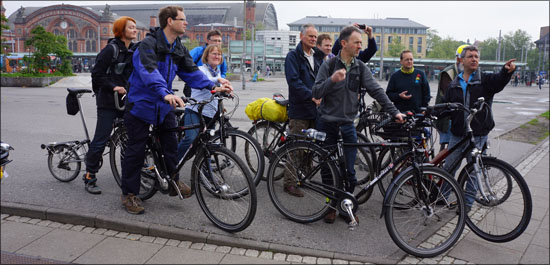
Yesterday we welcomed members of Cambridge Cycling Campaign to Bremen for a tour of the city's infrastructure. The fact that the Campaign contacted us, rather than the ADFC or the local authority, is itself a significant reflection of Bremen's lack of official international engagement. But we were more than happy to offer a semi-outsider's narrative of why our home city is so cycling friendly.

The tour itself took in a series of examples of infrastructure that explained the historical and cultural stories behind Bremen's remarkable status as the German cycling city - one of the first cycle paths (early 1900's) along Am Wall; the rather tired and ageing cycle paths of the 1920's that are suffering from tree roots, the site of the great battle of the 1970's, Mozartstrasse, that stopped the building of an urban motorway through a residential district and helped transform the city's transport policy; the resultant calming of the area through a series of one-way streets for motor traffic, all passable two-way for cyclists; the provision of decent-quality cycle paths along all major routes; and some of the most recent developments, such as a new protected cycle lane on Herdentor, created through the conversion of a full-width traffic lane. 

Throughout the three-hour tour, we were followed by a very friendly camera crew from Radio Bremen, who wanted to produce a short piece for that evening's local news transmission. Now we were so caught up in preparing the content of the tour - you know the stuff, history, culture, technical standards of infrastructure and so on - that we quite overlooked the media take on what we were doing, and how it might be redacted by our nice TV crew.  Radio Bremen, along with the wider trend in broadcast television, is increasingly interested in populist angles, amusing titbits that make the audience smile, but might not impart much knowledge about the subject in question. But sometimes it works.

Let's have a bit of fun ourselves, shall we, and consider the piece that went out last night her in Bremen:


Viewers who understand German will have already taken in much of what is to follow, but for the rest here is a brief explanation.

The opening intro describes Cambridge as the city with the highest number of Nobel Prize winners in the world. But here comes a delegation from the city who want to learn something from us, ie German cycling culture. We cut to the first shot from the report - of James, the most eccentric-looking (ie typical English prof type) of the delegation (as it happens I would add one of the most intelligent and thoughtful). Cue Elgar music and the first voice over "This here is for many, many Bremer the worst of all - a bicycle journey around the Stern roundabout....But for the lobby group from Cambridge, it's a paradise".

James explains to camera why it is good (the cross-hatching separating cyclists from traffic), and that it's something worth trying in  the UK. First statement of disbelief from the reporter, given that this roundabout is an accident hotspot. But bear in mind, the whole point of introducing the cross-hatching, which was added just 3 years ago, is to try to reduce these accidents. We filmed previous visitors (from Newcastle Cycling Campaign) to this roundabout last year:


Another member of the Cambridge Campaign, Klaas Brumann, then explains a key point - that Bremen motorists are much more mindful of cyclists than their English counterparts, and this helps at the roundabout.

On to another scene, and another Cambridge campaigner, Martin, marvels at the quality of Bremen cycling infrastructure. Second statement of disbelief from the reporter. "Strange, we Bremer are not so enthusiastic. The cycle paths are too narrow, and haven't been improved enough". The dearth of cycling infrastructure in England is then explained.

We then cut to a shot of a row of parked kids bikes, probably outside a kindergarten. We explain how good infrastructure means freedom for kids on bikes, even at the age of 4. And for German viewers, it is explained that young kids "don't cycle". Not strictly true, of course, they "play" on their (normally stabiliser-equipped) bikes, but don't go to nursery on them.

The piece ends with a funny quip about one universal characteristic of cyclists everywhere - their hatred of car drivers. We return to James, who declares that "pedestrians deserve the best surface, cyclists the second best, and motorised vehicles the worst. Motorists don't need a flat surface." Even so, the reporter is happy that visitors to Bremen have come, seen, and enthused about cycling in the city.

Did it work? I suspect the piece made Bremen viewers smile at the stereotypical English James. And in between the smiles, perhaps it was helpful to remind people that they've got, by international standards, a good quality network of cycling infrastructure. Even we can get too caught up in the internal debates around the Bremen Traffic Development Plan, and forget the solid grounding that underlies much of what is done in Bremen.

What we don't see in this particular edit is the scene right at the beginning of our tour, when we are showing the map of Bremen cycling infrastructure to our visitors, and the looks of disbelief on their faces.


As we explained, every red line on this map represents a cycle path. And every busy, main road has a cycle path alongside it. This is something that campaigners in the UK can only dream of. Yet it is now built into the DNA of Bremen (though not all German) traffic planners. Busy main roads must provide for good quality, safe and attractive cycling infrastructure. This is what makes Bremen a cycling city. This is what the Cambridge visitors really appreciated.

Tuesday, 5 March 2013

Cycling City in the Sunshine

 This winter has been one of the greyest on record in Germany. Never mind the cold temperatures, it has been the permanent cloud that has really got the population into a depression these last few weeks, with few people venturing out in their spare time. There was really only one exception - the wonderful Bremen tradition of Kohl und Pinkelfahrt in January and February. 

But yesterday the first sunshine for what seemed like months finally arrived, and today it was even slightly warm. And in Bremen that means that thousands of people, young, middling and old, meet up along the river after school or work, or if they're lucky earlier in the day, to soak up the joy-giving rays of sunshine. And inevitably, most of them get to and from the river by bicycle.

Many people gather in groups on the river dyke to chat, play ball games or have an impromptu drink. Groups like this one, older teenagers, will have cycled at least 2 or 3 kilometres from school, and will be cycling another 3 or 4 kilometres to their various homes. In towns and cities where cycling is not the norm, these events are unlikely to take place. Schoolkids who rely on public transport, walking, or even worse being collected by mama taxi service, find it a real hassle to take such a detour on their way home. But here it is part of the deal that comes with the independence cycling offers.

The great thing is that, on days like this, all kinds of people arrive by bike to enjoy the sun, side by side, in their different ways. As we moved along the river, our first thought was that a fair number of people might have arrived by some other means, since we often spotted them without bicycles. But then we watched as individual started to head off home and, almost inevitably, they walked the 30 metres or so to where their bicycle was parked before cycling off. Far more people, it seems, are cycling into the sun today.


Friday, 27 January 2012

Space Reallocation - An Example in Britain

Cycling Embassy of Britain is asking cycling policy activists to contribute to their debate about infrastructure this weekend, and we are happy to help as much as we can.

There is a very interesting and successful example in Britain, in the city of Hull: Here they dared to take considerable space away from cars by re-organising dual carriage ways: “The project involved reallocating road space on seven busy roads within the city through the introduction of cycle lanes. This was achieved by removing one lane of traffic in each direction which was then replaced by a cycle lane and parking bays.” They also allowed cyclists clear priority at junctions. That was not expensive but they were able to raise the number of cyclists considerably by 100 % in the same year as its installation and to reduce accidents by 55%.

The quality of these cycle lanes is not necessarily the best. But the point of this example is the amount of road space that has been taken from motorised traffic and reallocated to cycling. The allocation of road space is a key factor in any infrastructure development, and as cycling advocates are well aware, the UK’s track record on this is pretty poor. Here in Hull we have an example that shows that even in the UK reallocation of space is possible.

If you want to read more and see pictures, look at this short paper by Hull City Council and Cycling England about one of the roads:

http://webarchive.nationalarchives.gov.uk/20110407094607/http://www.dft.gov.uk/cyclingengland/site/wp-content/uploads/2008/09/hessle_road_hull.pdf

There is also a report by SQW Consulting to Cycling England from December 2008, where they compare five different projects in England but Hull gets the best results:

http://www.nici.org.uk/downloads/planning-for-cycling-report-10-3-09.pdf

The Hull project is described on pages 30 and 48 to 50, and for a better assessment of the results see page 39.

Wednesday, 31 March 2010

Beauty and the Bike-What Happened Next?


The excitement of the film premiere is over. Back we go to "normal" life in Darlington. We've managed to keep the beautiful dutch bikes - in fact we're going to buy 40 more this year and expand the bike hire scheme. But how many girls will keep on cycling? We know that cycling is still "uncool" for many UK teenagers - perhaps because it feels so unsafe on our meagre infrastructure? Here, one of the girls from Beauty and the Bike, Lauren Pyrah, comes behind the camera to ask what is happening to the Darlington girls now. Kate, one of the original group, is joined by Francesca to shout the praises of everyday cycling. But Ashley has stopped. Why? And will politicians listen?

Tuesday, 19 May 2009

Project on Councillor Wallis's Blog


Richard Grassick, one of Darlington Media Group's producers of the Beauty and the Bike project, is interviewed by Councillor Nick Wallis, Darlington Borough Council Cabinet Member for Climate Change.

Saturday, 2 May 2009

Lauren Pyrah’s Story


Back in Darlington after a wonderful and informative trip to Bremen, the girls in the project now find out if their cycling habits can become permanent in Darlington - even when our cycling infrastructure is still in its infancy.

This short video edit follows one of the girls, Lauren Pyrah, from her original interview in July 2008 to her current impressions, now she has been to a cycling-friendly city and returned to Darlington.

Lauren has hired one of the Velodarlo Dutch Bikes. She will be blogging her experiences on Darlington's streets on this website. Just select "Lauren's Blog" from the BikeBeauty Blogs drop down menu on the left of this page.

Wednesday, 29 April 2009

The Forgotten Art of Political Rebellion ?


Our project includes a youth exchange with the German state of Bremen. On Monday one of the project's researchers met Dr. Reinhard Loske, Bremen's Senator for the Environment, Building, Europe and Transport, to discuss his work on improving Bremen's already good cycling infrastructure.

He also appears in the following video, advocating speed limits for Germany's motorway network. In fact, he is imposing these speed limits on all the motorways in Bremen State anyway.
In Germany, motorways without speed limits is gospel. Like America's freedom to bear weapons, the vast majority of Germans see fast driving on motorways as sacrosanct. Dr. Loske is not exactly the establishment's favourite politician, limiting their god-given freedom to burn fuel. But he understands when it's necessary to confront national orthodoxy - to rebel. Even when this means taking on the most powerful political lobby in Germany, the car industry.

Our own "national orthodoxy", as far as transport is concerned, also revolves around the car. To deny our citizens their god-given right to drive the kids 500 yards to school, to the shops, or to the local office, is not only too much for our politicians, but "corridors of certainty" are required to make the trip faster, easier, and more direct.

Heaven forbid the idea that we might disrupt this sacred tarmac by taking a square inch of road space away from the car to construct safe cycle paths. The only space available for such fanciful stuff round here seems to be pavements. If there is a definition of the political rebel that we need here in Darlington, it is the politician brave enough to state the obvious - road space, especially on our main roads, needs to be taken from cars.

The local authority have successfully encouraged many Darlingtonians to switch from car to bicycle. But a cursory count on the streets of the town will tell you that, unlike we seasoned cyclists, these beginners are very often seen on our pavements. The main roads are clearly regarded as just too dangerous.

Our "national orthodoxy" reaction to this, of course, is to curse and scream at those wicked cyclists - and we all know how easily this attitude spreads to include all cyclists. But the brave politician, the politician willing to reflect and understand, must rebel against this orthodoxy, defend cyclists, and state the obvious conclusion. These new cyclists need proper infrastructure.

So until the day we hear this on our own transport agenda, lets celebrate the art of political rebellion, German style with this short video.

Tuesday, 7 April 2009

Bremen Day 2 - Kate


Kate sums up the second day in Bremen.

Bremen Day 1 - Sofija


Sofija Kriauciunaite has just arrived in Bremen with the rest of the Beauty and the Bike girls from Darlington. Here she gives her first impressions of the place.

Sunday, 5 April 2009

Why Do Girls Stop Cycling?


Our project is founded on the fact that girls in cycling friendly countries continue to cycle into adulthood, whilst in other countries - like the UK - they tend to give up during the teenage years. Why?