Showing posts with label Europe. Show all posts

Wednesday, 29 May 2013

The Media and the Message


What with the ongoing Times Cities Fit For Cycling campaign, and the significant debates surrounding the Parliamentary Enquiry into Cycling, it's easy to forget the typical media take on cycling. 

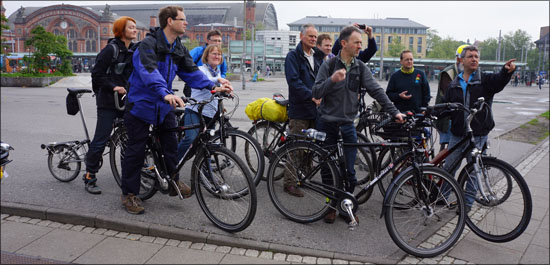
Yesterday we welcomed members of Cambridge Cycling Campaign to Bremen for a tour of the city's infrastructure. The fact that the Campaign contacted us, rather than the ADFC or the local authority, is itself a significant reflection of Bremen's lack of official international engagement. But we were more than happy to offer a semi-outsider's narrative of why our home city is so cycling friendly.

The tour itself took in a series of examples of infrastructure that explained the historical and cultural stories behind Bremen's remarkable status as the German cycling city - one of the first cycle paths (early 1900's) along Am Wall; the rather tired and ageing cycle paths of the 1920's that are suffering from tree roots, the site of the great battle of the 1970's, Mozartstrasse, that stopped the building of an urban motorway through a residential district and helped transform the city's transport policy; the resultant calming of the area through a series of one-way streets for motor traffic, all passable two-way for cyclists; the provision of decent-quality cycle paths along all major routes; and some of the most recent developments, such as a new protected cycle lane on Herdentor, created through the conversion of a full-width traffic lane. 

Throughout the three-hour tour, we were followed by a very friendly camera crew from Radio Bremen, who wanted to produce a short piece for that evening's local news transmission. Now we were so caught up in preparing the content of the tour - you know the stuff, history, culture, technical standards of infrastructure and so on - that we quite overlooked the media take on what we were doing, and how it might be redacted by our nice TV crew.  Radio Bremen, along with the wider trend in broadcast television, is increasingly interested in populist angles, amusing titbits that make the audience smile, but might not impart much knowledge about the subject in question. But sometimes it works.

Let's have a bit of fun ourselves, shall we, and consider the piece that went out last night her in Bremen:


Viewers who understand German will have already taken in much of what is to follow, but for the rest here is a brief explanation.

The opening intro describes Cambridge as the city with the highest number of Nobel Prize winners in the world. But here comes a delegation from the city who want to learn something from us, ie German cycling culture. We cut to the first shot from the report - of James, the most eccentric-looking (ie typical English prof type) of the delegation (as it happens I would add one of the most intelligent and thoughtful). Cue Elgar music and the first voice over "This here is for many, many Bremer the worst of all - a bicycle journey around the Stern roundabout....But for the lobby group from Cambridge, it's a paradise".

James explains to camera why it is good (the cross-hatching separating cyclists from traffic), and that it's something worth trying in  the UK. First statement of disbelief from the reporter, given that this roundabout is an accident hotspot. But bear in mind, the whole point of introducing the cross-hatching, which was added just 3 years ago, is to try to reduce these accidents. We filmed previous visitors (from Newcastle Cycling Campaign) to this roundabout last year:


Another member of the Cambridge Campaign, Klaas Brumann, then explains a key point - that Bremen motorists are much more mindful of cyclists than their English counterparts, and this helps at the roundabout.

On to another scene, and another Cambridge campaigner, Martin, marvels at the quality of Bremen cycling infrastructure. Second statement of disbelief from the reporter. "Strange, we Bremer are not so enthusiastic. The cycle paths are too narrow, and haven't been improved enough". The dearth of cycling infrastructure in England is then explained.

We then cut to a shot of a row of parked kids bikes, probably outside a kindergarten. We explain how good infrastructure means freedom for kids on bikes, even at the age of 4. And for German viewers, it is explained that young kids "don't cycle". Not strictly true, of course, they "play" on their (normally stabiliser-equipped) bikes, but don't go to nursery on them.

The piece ends with a funny quip about one universal characteristic of cyclists everywhere - their hatred of car drivers. We return to James, who declares that "pedestrians deserve the best surface, cyclists the second best, and motorised vehicles the worst. Motorists don't need a flat surface." Even so, the reporter is happy that visitors to Bremen have come, seen, and enthused about cycling in the city.

Did it work? I suspect the piece made Bremen viewers smile at the stereotypical English James. And in between the smiles, perhaps it was helpful to remind people that they've got, by international standards, a good quality network of cycling infrastructure. Even we can get too caught up in the internal debates around the Bremen Traffic Development Plan, and forget the solid grounding that underlies much of what is done in Bremen.

What we don't see in this particular edit is the scene right at the beginning of our tour, when we are showing the map of Bremen cycling infrastructure to our visitors, and the looks of disbelief on their faces.


As we explained, every red line on this map represents a cycle path. And every busy, main road has a cycle path alongside it. This is something that campaigners in the UK can only dream of. Yet it is now built into the DNA of Bremen (though not all German) traffic planners. Busy main roads must provide for good quality, safe and attractive cycling infrastructure. This is what makes Bremen a cycling city. This is what the Cambridge visitors really appreciated.

Monday, 11 February 2013

Reports from a Cycling City2 - Bremen's Cycling Plan

The 5 Consultation Areas
Like many European towns and cities, Bremen is in the process of producing its transport plan for the next 10 to 15 years. In the UK it is known as LTP3. Here, using the German language's love of crushing together a string of words into one, we called it the Verkehrsentwicklungsplan, or VEP for short. Last month, I went along to one of the public consultations to see how they compared with the UK experience. The basis of the presentation is available online here. The consultation process involves 5 sessions for each of 5 areas in Bremen. This particular meeting was for central Bremen, where we live.

The first thing that struck me was that, in this city with around 25% of everyday trips being made by bicycle, cycling was given equal weight throughout the proceedings to all other modes of mobility. For example, following the initial presentations by the officers and their consultants (more on which later), the audience was given four standing areas to visit and comment, one for each of public transport, private motorised transport, walking, and cycling. In a way, it felt as though cycling was a given in terms of such status, and this time extra efforts were being made to give walking a higher status than previously afforded.

The Cycling Stand
At each of these stands, an officer or consultant was on hand to discuss issues with members of the public. Alongside the maps and statistics was a blank canvas. We were invited to fill in different coloured cards with suggestions - blue cards for wishes, green cards for positive aspects of the existing infrastructure that should be build on (Anknüpfungspunkte means something like starting points), and yellow cards for negative comments.

The Cycling Canvas 
The blue "wishes" cards tend to argue for more space for cyclists, the green for more priority for cyclists, and the yellow identified individual problems - cobbled streets, the technical prohibition of cyclists in the city centre pedestrian zone (most cyclists ignore this), and so on. The consensus seems to be that Bremen has done well in the past, but that now a lot more needs to be done. Much of Bremen's cycling infrastructure dates back 40 years or more - the first Bremen cycle path was constructed in 1897! Sure enough, the statistics show that, when compared to the large German cities, Bremen has the highest cycling modal share of all. But how to progress?

During the initial presentations, it seemed that there was little critical contemporary evidence about cycling figures, whether they were rising or falling, who was cycling where. The available figures date back to 2008, now nearly 5 years old, and make for interesting reading. They show that, in Bremen as a whole, cycling's share of all journeys stands at a healthy 25%. In our area, Bremen Mitte, this rises to 28%. Moreover all sustainable travel modes are higher than the Bremen average in our area. In contrast, car use in the city stands at 40%, whilst in Bremen Mitte this falls to just 18%. This is significant.

Bremen's Modal Split. Our area is highlighted in red.


We often hear from politicians in the UK that they are restricted in what they can do for cycling because of the democratic process. The argument goes something like this. "In a democracy politicians have to take the views of the electorate into account. If most voters drive rather than cycle, and cycling is in fact the domain of a few per cent of the population, then clearly the needs of motorists have to take precedence over cyclists. Thus, in a democracy, streets should be designed with the typical voter in mind".

You would expect, then that in the centre of Bremen, the opposite might be the case. Well here is our street:


Something like 30% of the available street space, once pavement and road are taken into account, is allocated to parking for cars. This is a relatively quiet residential street, and because there are so many cyclists compared to drivers, most of the time cyclists feel safe to use the road, with car drivers accepting they should follow slowly (it is also a 30kph zone). All the same, it does seem rather generous to the 18% to give them so much space simply to park their tin cans.

But the problem becomes acute when we look at the road at the far end of this picture, Sielwall, which is deemed a main through road with a 50kph speed limit.


As this is a busier road with a 50kph speed limit, a cycle path runs along both sides of the road. But as you can see, parked cars tend to edge into the already too narrow path. The blue parking sign at the top of the picture instructs drivers to park partly on the road way and partly on the narrow strip of pavement between cycle path and road. But in practice, drivers move most of their vehicle up on to the pavement, probably in fear of their wing mirror getting clipped. Parking on this stretch of street amounts to around 20 spaces, yet it disrupts the safe flow of traffic for both cyclists and pedestrians alike.

So how does Bremen propose to address these problems? Back at the presentation, there was much talk of cycling as the "new cool", and of  the phenomenon of car-free living, Autofrei Leben, an increasingly attractive option for inhabitants of large cities like Bremen that have good public transport, car sharing schemes, and reasonable cycling infrastructure. No specific target figure for increased cycling was presented, although 30% was mentioned briefly in passing during a summing up. This perhaps reflects the rather imprecise cycling aims that currently appear in the official VEP Plan document:
  • promote cycling
  • improve cyclist safety
  • improve cycling infrastructure 
Interestingly, there is a clear aim in that document to "shift private motorised transport towards public transport", but there is no apparent equivalent for cycling. It is fair to say that the VEP's concrete project proposals will be developed over the coming months, so there is an inevitable vagueness about things to date. Moreover, there are a number of wider aims, for example dealing with environmental and urban planning issues, that suggest that cycling has a wider role to play. But even so, there is surely space for a clearer cycling strategy at this stage.

Bremen is often characterised as a "leading" cycling city, on the verge of becoming classified as a "cycling champion" or "pioneer" (the German national Cycling Plan's term) by the professionals. Indeed, the EU-funded PRESTO project has already done so. In these circumstances, perhaps two questions  need to be asked. First, how do we keep existing cyclists happy on their bikes? Second, how do we raise that modal share figure further? According to Germany's current National Cycling Plan, pioneer municipalities like Bremen have little need for promotion - cycling as an everyday means of transport is self-evident - but rather needs to concentrate its efforts on infrastructure projects.

It also makes sense, when so many of the complaints from existing cyclists relate to the inadequacies of Bremen's ageing cycle paths, that priority is given to upgrades of existing infrastructure. For example, Copenhagen's Bicycle Strategy 2011-2025  includes a target that "80% of cyclists find the cycle tracks well maintained (2010: 50%)". So far in Bremen, such an approach, to upgrade existing cycling infrastructure, does not appear to have been adopted. But attitudes towards Bremen's ageing cycle paths, and how problems such as that highlighted on Sielwall, constitute the key debates around Bremen's cycling vision. How that debate is resolved will have a major bearing on whether Bremen moves forward as a cycling champion, or sees its long history of everyday cycling eroded just when the wider world has woken up to its significance.

Wednesday, 23 January 2013

Reports from a Cycling City

Bremen Cycle Chic
Bremen Cycle Chic?
Whatever happened to Bremen's online presence in the global cycling advocacy community?

There's a better than good chance that anyone reading this post will be well aware of the great blogs that emanate from the world's most famous cycling cities. From the various -ize websites, Amsterdamize, Copenhagenize, Portlandize, to the Cycle Chic republic of blogs, to more unique sites like  A View from the Cycle Path and BikePortland, local cycling advocates routinely share their experiences in a cycling city with the outside world. They sit alongside an even more impressive range of  blogs from activists in towns and cities around the world - London, New York, Munich, Newcastle,  that are striving to achieve cycling-friendly status. The dialogue between us all has created a strong sense that we are not only looking at developments at home, but looking outward, with, in the case of cycling cities, a sense of pioneering, or in the case of striving cities the desire to learn and progress.

Strange then, that here in Bremen, a city that boasts a cycling modal share of 26%,  there is no such discernable web presence. Having scoured the web for any sign that Bremen has a pioneering cycling culture that is in tune with the best cycling initiatives being developed around the world, I could not find one. Instead, there are three web presences that might be said to represent cycling in Bremen.

First, there is the official website of ADFC Bremen, the rather large city branch of the national cycling organisation of Germany. As the mouthpiece for an official organisation, its job is to publicise their agreed aims, campaigns, and successes. Whilst the ADFC's campaigning work should be commended, its connections with deeper debates about cycling policy in the outside world is therefore limited.

Second, there is the official website of the municipality itself. Here you need to dig deep to get to the various cycling pages, but of course they are all about current or past transport policy. Right now the municipality is working on developing a new Transport Development Plan (in German Verkehrsentwicklungsplan or VEP for short). Nothing here suggests that Bremen is aware of its global standing alongside other cities like Amsterdam and Copenhagen as a cycling city that needs to be pioneering the most effective strategies to further cycling as a key means of transport.

 Third, there is one cycling website that does indeed have some connection with the wider world, but in the most peculiar way. Bremen Critical Mass organises monthly cycle rides, just like Critical Mass rides around the world, on the last Friday of each month. Unlike the vast majority of these, however, BCM is not campaigning for better cycling infrastructure. Rather, in a city that already boasts over seven hundred kilometres of separated cycle paths, they are riding for the right to cycle on the road, mixing with other traffic. This reflects recent legal battles about cyclists' rights in Germany. Until the late 1990's, wherever a cycle path existed, cyclists were legally expected to use it, no matter how poor its quality. Not surprisingly, the more sprightly cyclists felt that they would be better off using the road. So ADFC launched an ultimately successful campaign to repeal this obligation. BCM is in many ways an expression of that campaign.

None of these three sites has any connection with the world wide web's community of progressive cycling policy. And living here as a cycling activist, this makes the place feel even more parochial than dear old Darlington. To find a base from which to develop genuinely pioneering cycling policies, we are instead engaged as members of two groups. The Bremen Green Party is currently in power in the city in a coalition with the Social Democrats, and has a healthy internal debating mechanism for policy development. Over the past few months, it has been developing an update of their Master Plan for Cycling, and as ordinary members we have fed our thoughts and ideas into the process. The result is pretty positive, with a short-term aim of 30% modal share, and 50% in the longer term. Interestingly, it has just got a mention in the nearest -ize website to Bremen, hamburgize.com.

Secondly, we are working with Friends of the Earth (BUND) Bremen in a similar way, to develop a cycling policy that furthers the deeper aims of environmental protection and combating climate change.

Bremen needs to realise its potential as a pioneering cycling city. The lack of this public sense of a presence on the global bicycle culture stage - Bremen is regularly involved in official initiatives such as the EU funded PRESTO project - might be more a symptom of the city's lack of collective self-confidence about its self-image, rather than a cause, but either way we sense economic as well as intellectual deficits. There is little on the Bremen tourism website to attract cycling visitors, and new ideas to increase cycling are all coming from elsewhere, yet with no discernible impact on the local debate.

The fact is, Bremen's lack of self-confidence (yes, we are the poorest State in western Germany) has caused it to grossly under-estimate its own achievements to date, and its potential standing on the world stage. This is not simply a cycling deficit - our 700-odd kilometres of cycle path is twice the Copenhagen total - but in many other areas as well. Bremen has an abundance of protected green areas, it has a thriving local cultural scene, a loveable football team with a stadium that is surrounded by solar panels, and its public transport system is comprehensive, comfortable, and headed by an inspiring team that, for example, allow the homeless to ride the trams for free during a cold snap.

Bremen's past cycling achievements - most kids cycle to school, Bremen car drivers are much more cyclist-aware, and the considerable existing infrastructure - makes it a city that is culturally prepared for another great leap forward.  There is much to do to make Bremen's cycling infrastructure fit for a 50% modal share. That is exactly what the city should now focus on.

Sunday, 5 August 2012

A Brief Pause on the Cycle Path


Today started wet, developed into cloudy, ended sunny. More solid cycle paths along country roads, with variable provision in the villages.

After 3 days of such wide open spaces, it then came as a bit of a shock to arrive in Kühlungsborn.


Ah well. It got us out of the hotel and away from this iPad!

-Posted using BlogPress from my iPad

Friday, 3 August 2012

Schwerin


So as planned we take the train to Schwerin, along with 14 other bicycles. Here we are in the cycle wagon, somewhat full and, contrary to German stereotypes, most bikes have been placed in the wrong space. You book a space for your bike on inter-city trains in Germany, but we found ours were already occupied when we got on the train, so had to take someone else's.
Once in Schwerin we decided on an afternoon ride around the large lake; very pretty, and a rather famous grand castle at the start. After 30 kms the rain closed in, so we had a fast peddle back to the hotel.
As for cycling infrastructure, cyclists are fairly well catered for on the tourist circuit. Once in Schwerin, things are a bit less so. But in both cases an obvious strategy has been developed. Bearing in mind that the town was until 25 years ago part of the GDR, in that short time a fair amount has been done for cyclists, but based on this expedient of simply converting pavements to shared use cycle/pedestrian routes. The main road into Schwerin has this all the way down into town. As does much of the lake circuit, for example when passing through villages.
But the expedient works for two reasons. First, pedestrians expect cyclists. And second, motorists are trained to give way to both pedestrians and cyclists at junctions. It's not perfect. There was a strategy in place for developing cycling in Schwerin, but it seems the town council have ditched it in May. The German link suggests a familiar experience - politicians apparently listening to local cycling representatives, then suddenly ditching the whole discussion.
Be that as it may, Schwerin has its positive points. There is certainly a strong cycling culture here, there are still trams running as I write this after midnight, and the town centre's pedestrian heart is more fully pedestrian than Darlington. Yes, there are cyclists (though not during peak hours, sadly), but perhaps more interesting is the way in which buses travel through the pedestrian area.


Buses travelling at this kind of speed reinforce the idea that this part of the town belongs to the pedestrian, and others are invited. Intriguingly, we watched taxi drivers and a security car driver ignore this concept, suggesting that there is a clear political attempt, via the local bus company, to develop a culture of slow traffic in the town centre.

These phenomena - motorists giving way and slow buses- are no god-given behaviours. They are deliberately fostered by political will. The other side of the coin? I leave that to you, the reader, to describe.

Posted using BlogPress from my iPad

Thursday, 2 August 2012

Pootling to Copenhagen


View Larger Map

Well, after all the travelling around Europe with our film, it's time to have a proper cycling holiday. And what better way to spend a week than cycling through northern Germany and Denmark to Copenhagen.

We're travelling with two good friends who live in nearby Lillienthal, and will be deliberately restrained about the distances we cover on the bikes. Lazy sods that we are, we'll happily take a train when time is tight or weather is crap. In fact we decided to get a head start and take a slight detour by train to Schwerin (B) tomorrow, thanks to the cheap tickets available here, and the easy booking of bicycles. Schwerin is the same size as Darlington, so it will be intriguing to compare traffic and cycling provision.

Then to Wismar, (C) and a few days on the Baltic Sea to Rostock (F). A couple of days will be spent as I try to reconnect with some people from the Amber Film I helped make there 25 years ago. Then a ferry to Gedser (G), a bit of pedalling north, and at some point in the same day a train up to Roskilde (I). Between there and Copenhagen we might just do a bit exploring around the north coast. Then it's back to Bremen on a train (yep, cheap tickets again). So this will be no great feat of sporting achievement a la Olympics, but rather a gentle pootle along proper cycle paths.

We'll be recording the trip, of course, but what we'll be interested in is the standard of signposted infrastructure in Germany and Denmark. There's an ongoing programme of long-distance cycle route building going on here, and standards are generally very good. Even so, there have been cuts in the budget, from 94 million euros in 2010 to 60 million euros this year. Denmark, on the other hand is, outside the well-documented story of Copenhagen, an unknown to us. Some of the official cycle routes we explored on google street view looked distinctly British in nature, ie no cycle path on a busy road. The picture here, for example,  is on one such official route, between Praesto and Faxe.


View Larger Map

But there's nothing like seeing the real thing for yourself, so with iPad in Ortlieb bag we're off tomorrow!

Wednesday, 23 May 2012

Homage to Auto*Mat


Beauty and the Bike's screening in Prague in 2011 coincided with a critical mass ride organised by local NGO Auto*Mat. Here we celebrate the great work of that organisation, and meet some of their enthusiastic young members.

Prague is one of the most car-oriented cities we visited on our tour of the continent, in many ways even more of a nightmare than the UK. Auto*Mat combine engagement with local authorities through the production of cycling-friendly urban development proposals for the municipality, with direct action and participatory events like these monthly critical mass rides. Thousands regularly attend, making them an incredible celebration of a few hours of cycling/skateboarding/scootering on car-free streets. Amazingly, the majority of those take part will bring their bikes in a car or by public transport, rather than risk cycling in ones or twos. It's that dangerous.

One feature of the Critical Mass Ride that really caught our eye was the presence of a number of young people from Danish Embassy. Unlike officialdom and their many hangers-on in the UK, who look down on such street actions as an obstruction to traffic and generally the preserve of the unwashed hooligan, the Danes celebrated the bicycle alongside their Auto*Mat friends by joining in with an official presence, both on the ride and later by joining in the speeches at the ride's destination venue.

Visit Auto*Mat's English-language web presence, at http://www.livable-cities.org/en/prague/prague-about-us/ to get an idea of their work. Or if your Czech is up to it, try http://www.auto-mat.cz/ for the latest news from Prague. Auto*Mat are part of a thriving movement for change in Prague. If you ever visit the city, try ditching the usual tourist crap and instead explore some of the great local projects in and around the lesser-known urban areas. For a useful overview of such initiatives, check out the Urban Garden website.

Tuesday, 18 January 2011

Learning from Copenhagen (and elsewhere)

More evidence that informed thinking about successful cycling policies is coalescing around a move towards high quality and safe infrastructure on our arterial routes, couple with traffic calming on all residential streets. An interesting exchange of letters between Richard Lewis, a principal town and transport planner at the London Borough of Newham, and Dave Horton from Lancaster University, asks how much we can learn from the "Copenhagen model", a somewhat PR-influenced shorthand for "best European practice" as spelt out lucidly and repeatedly by our friend from Assen, David Hembrow

Dave Horton visited Copenhagen at the beginning of December as part of a wider piece of research called On Our Own Two Wheels, documenting the experience of riding a bicycle in cities around the world. The exchange of letters followed that visit.

As David Horton concludes:

“I think increased provision of specific and segregated cycling infrastructure might be key to getting the velorution rolling. The current and massive problem with otherwise wonderful initiatives such as Bikeability (a UK cycle training scheme, not to be confused with the Danish research project of the same name!) is that, given the existing cycling environment, we’re destined to lose the vast majority of those we train. However well we train them, only the hardy minority will stay on their bikes for long. We have strategically to crack, and then mine, the current dominance of car-based urban automobility, and the establishment of cycling corridors – a la Copenhagen and (in a fashion) London – on key, highly visible arterial routes seems one way of doing so.”

This echoes our conclusion which we published a year ago on this website. What is becoming clear is that such policies cannot be delivered at a purely local level, whatever the new government rhetoric about localism. Local cycling policies are dominated by the DfT's and CTC's hierarchy of provision, which ironically puts infrastructure at the bottom of the list in a table of "considerations" for local authorities to follow. Unlike the fate of Cycling England, this particular policy is likely to survive for some time

Dave Horton concludes his post with notice of a gathering of like minds at The Phoenix Digital Arts Centre in Leicester on Saturday 4th and Sunday 5th June 2011. Perhaps this will come up with strategies for making national in the UK, cycling policies that clearly are "best practice" elsewhere.