Showing posts with label Road allocation. Show all posts

Wednesday, 29 May 2013

The Media and the Message


What with the ongoing Times Cities Fit For Cycling campaign, and the significant debates surrounding the Parliamentary Enquiry into Cycling, it's easy to forget the typical media take on cycling. 

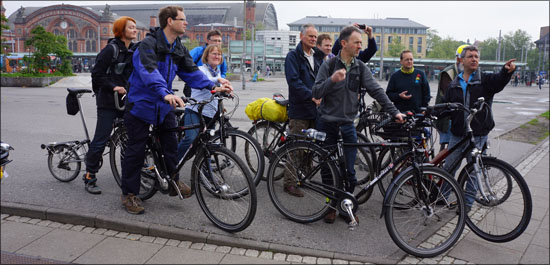
Yesterday we welcomed members of Cambridge Cycling Campaign to Bremen for a tour of the city's infrastructure. The fact that the Campaign contacted us, rather than the ADFC or the local authority, is itself a significant reflection of Bremen's lack of official international engagement. But we were more than happy to offer a semi-outsider's narrative of why our home city is so cycling friendly.

The tour itself took in a series of examples of infrastructure that explained the historical and cultural stories behind Bremen's remarkable status as the German cycling city - one of the first cycle paths (early 1900's) along Am Wall; the rather tired and ageing cycle paths of the 1920's that are suffering from tree roots, the site of the great battle of the 1970's, Mozartstrasse, that stopped the building of an urban motorway through a residential district and helped transform the city's transport policy; the resultant calming of the area through a series of one-way streets for motor traffic, all passable two-way for cyclists; the provision of decent-quality cycle paths along all major routes; and some of the most recent developments, such as a new protected cycle lane on Herdentor, created through the conversion of a full-width traffic lane. 

Throughout the three-hour tour, we were followed by a very friendly camera crew from Radio Bremen, who wanted to produce a short piece for that evening's local news transmission. Now we were so caught up in preparing the content of the tour - you know the stuff, history, culture, technical standards of infrastructure and so on - that we quite overlooked the media take on what we were doing, and how it might be redacted by our nice TV crew.  Radio Bremen, along with the wider trend in broadcast television, is increasingly interested in populist angles, amusing titbits that make the audience smile, but might not impart much knowledge about the subject in question. But sometimes it works.

Let's have a bit of fun ourselves, shall we, and consider the piece that went out last night her in Bremen:


Viewers who understand German will have already taken in much of what is to follow, but for the rest here is a brief explanation.

The opening intro describes Cambridge as the city with the highest number of Nobel Prize winners in the world. But here comes a delegation from the city who want to learn something from us, ie German cycling culture. We cut to the first shot from the report - of James, the most eccentric-looking (ie typical English prof type) of the delegation (as it happens I would add one of the most intelligent and thoughtful). Cue Elgar music and the first voice over "This here is for many, many Bremer the worst of all - a bicycle journey around the Stern roundabout....But for the lobby group from Cambridge, it's a paradise".

James explains to camera why it is good (the cross-hatching separating cyclists from traffic), and that it's something worth trying in  the UK. First statement of disbelief from the reporter, given that this roundabout is an accident hotspot. But bear in mind, the whole point of introducing the cross-hatching, which was added just 3 years ago, is to try to reduce these accidents. We filmed previous visitors (from Newcastle Cycling Campaign) to this roundabout last year:


Another member of the Cambridge Campaign, Klaas Brumann, then explains a key point - that Bremen motorists are much more mindful of cyclists than their English counterparts, and this helps at the roundabout.

On to another scene, and another Cambridge campaigner, Martin, marvels at the quality of Bremen cycling infrastructure. Second statement of disbelief from the reporter. "Strange, we Bremer are not so enthusiastic. The cycle paths are too narrow, and haven't been improved enough". The dearth of cycling infrastructure in England is then explained.

We then cut to a shot of a row of parked kids bikes, probably outside a kindergarten. We explain how good infrastructure means freedom for kids on bikes, even at the age of 4. And for German viewers, it is explained that young kids "don't cycle". Not strictly true, of course, they "play" on their (normally stabiliser-equipped) bikes, but don't go to nursery on them.

The piece ends with a funny quip about one universal characteristic of cyclists everywhere - their hatred of car drivers. We return to James, who declares that "pedestrians deserve the best surface, cyclists the second best, and motorised vehicles the worst. Motorists don't need a flat surface." Even so, the reporter is happy that visitors to Bremen have come, seen, and enthused about cycling in the city.

Did it work? I suspect the piece made Bremen viewers smile at the stereotypical English James. And in between the smiles, perhaps it was helpful to remind people that they've got, by international standards, a good quality network of cycling infrastructure. Even we can get too caught up in the internal debates around the Bremen Traffic Development Plan, and forget the solid grounding that underlies much of what is done in Bremen.

What we don't see in this particular edit is the scene right at the beginning of our tour, when we are showing the map of Bremen cycling infrastructure to our visitors, and the looks of disbelief on their faces.


As we explained, every red line on this map represents a cycle path. And every busy, main road has a cycle path alongside it. This is something that campaigners in the UK can only dream of. Yet it is now built into the DNA of Bremen (though not all German) traffic planners. Busy main roads must provide for good quality, safe and attractive cycling infrastructure. This is what makes Bremen a cycling city. This is what the Cambridge visitors really appreciated.

Wednesday, 22 February 2012

From Road to Cycle Path and Back Again

The meeting of local residents last night on Humboldtstraße
When Objective and Subjective Safety Clash

Last night saw what for me was a remarkable sight - a local authority anticipating the digging up of a road by one of the utilities (in this case water to renew a main sewer), and actually planning to take advantage by developing plans for infrastructure improvements when the work is finished and the road needs relaid. What's more this is the Viertel in Bremen, an area of the city with higher than normal cycling rates in a city that averages 25%. Our local mayor Robert Bücking, who chaired the event, represents the Green Party that recently won 45% of the vote in our district at last year's election. Both local government policy and popular will were heavily weighted towards cycling-friendly improvements.

Local utility company HanseWasser will begin work on renewing the main sewer that runs beneath Humboldtstraße in April, and last night's meeting was called to discuss local authority proposals to convert the street into a Cycle Street following completion of the works. Humboldtstraße has a problem that is increasing in Bremen - cycle paths built in the 1980s that are deteriorating, whilst the numbers of cyclists using them continues to increase. Figures released at the meeting last night show that somewhere around 4,000 cyclists use the street daily, a number that is equal to the number of motor vehicles. Humboldtstraße is a residential street, with a series of small local shops dotted along the its 800 metre length. Though no arterial road, it is often used as a handy alternative link between the main city hospital and the city centre.
Humboldtstraße
The local authority proposal is to convert Humboldtstraße into a Fahrradstraße (Cycling Street), removing the existing cycle paths, narrowing the main road by a metre, and giving more space to the pavements, and car and bicycle parking. The street will continue as a 30kph (20mph) zone, but unlike now will have priority at all side junctions. Currently, junctions use the "priority to the right" system as an alternative to "give way" signs, but it seems in this case many drivers have historically acted as if Humboldtstraße already had priority over side streets.

One principle argument for Fahrradstraße is objective safety. Especially at junctions, cyclists are more visible on the main road when compared with the cycle path. In Germany, cycle paths and pedestrians have priority at side junctions, so any accidents involving a cyclist/motor vehicle collision will almost inevitably be due to the driver failing to see the cyclist. Such collisions are less likely to occur if the cyclist is out on the road. Of course this argument is used regularly by vehicular cyclists in the UK and USA, who have amassed considerable evidence to argue their case. But unlike these studies, the Fahrradstraße discussion last night was primarily concerned with quality issues. How would cyclist priority on the street work in practice? Is the 30kph speed limit respected by all users? What happens at night when there are few cyclists? Clearly on-road cycling here will be quite different to the average UK or USA road.

But most interesting of all, concerns from the audience, and women in particular, revolved around subjective safety. Many said they feared any kind of mixing with motorised traffic, and predicted they would instead cycle on the widened pavements promised in the plan. Others questioned whether the role given to cyclists - to calm motorised traffic - was fair on small children or the elderly. Here, the "experts" from the local authority, the ADFC (German Cyclists Federation), and even one local politician who explained her surprise when she was shown the statistics about Fahrradstraße safety, were unable to reconcile their objective statistics about safety with the subjective feelings expressed by members of the audience.

Yet subjective safety is a widely recognised and important concept. In this case, it raises the question about the "feel" of the street for users, and to what extent it is more of a space for slow moving traffic - pedestrians and cyclists - than for fast, or potentially fast-moving motorised vehicles. Many in the audience felt that giving Humboldtstraße continuous priority over all side streets will only encourage reckless driving, despite the speed limit. Humboldtstraße runs in a straight line from one end to the other. These criticisms seemed to suggest a wish for a street design that better stated the intentions of the planners to "tame the motor vehicle". One woman suggested taking motorised traffic out of the street altogether. Perhaps here there are even some lessons for Bremen from the UK after all.

It is gratifying that the public debate last night hardly touched on issues of convenience for motorised traffic. Pretty well all who attended agreed on the aim of making Humboldtstraße a better living street by reducing the dominance of the car (although that pesky issue of parking space remains a popular demand). But if our local authority is to properly address residents' concerns, a range of options from Fahrradstraße to Fussgängerzone (Pedestrian Zone) should now be explored. As one attendee said last night, Bremen is going through a deep cultural change, from car-centricity to liveable streets. But the journey from one to the other is not a simple one, and mistakes could be made on the way.

In a deeply democratic country like Germany, this debate will continue for some time to come here in the Viertel. We'll let you know how the proposals develop.

Friday, 27 January 2012

Space Reallocation - An Example in Britain

Cycling Embassy of Britain is asking cycling policy activists to contribute to their debate about infrastructure this weekend, and we are happy to help as much as we can.

There is a very interesting and successful example in Britain, in the city of Hull: Here they dared to take considerable space away from cars by re-organising dual carriage ways: “The project involved reallocating road space on seven busy roads within the city through the introduction of cycle lanes. This was achieved by removing one lane of traffic in each direction which was then replaced by a cycle lane and parking bays.” They also allowed cyclists clear priority at junctions. That was not expensive but they were able to raise the number of cyclists considerably by 100 % in the same year as its installation and to reduce accidents by 55%.

The quality of these cycle lanes is not necessarily the best. But the point of this example is the amount of road space that has been taken from motorised traffic and reallocated to cycling. The allocation of road space is a key factor in any infrastructure development, and as cycling advocates are well aware, the UK’s track record on this is pretty poor. Here in Hull we have an example that shows that even in the UK reallocation of space is possible.

If you want to read more and see pictures, look at this short paper by Hull City Council and Cycling England about one of the roads:

http://webarchive.nationalarchives.gov.uk/20110407094607/http://www.dft.gov.uk/cyclingengland/site/wp-content/uploads/2008/09/hessle_road_hull.pdf

There is also a report by SQW Consulting to Cycling England from December 2008, where they compare five different projects in England but Hull gets the best results:

http://www.nici.org.uk/downloads/planning-for-cycling-report-10-3-09.pdf

The Hull project is described on pages 30 and 48 to 50, and for a better assessment of the results see page 39.